Vancouver Save Article 9 was established in May, 2005 to work for preservation, realization, and promotion of Article 9, the war-renunciation clause of the Japanese Constitution. Since 2021, our activities have been mostly on-line, involving audiences in all Canada, Japan, and beyond. Our online identity is "Article 9 Canada." バンクーバー九条の会は2005年に設立されました。戦争放棄、武力不保持を誓う日本国憲法を守り、実現し、その精神を日本国外に広めるために活動しています。2021年より、「カナダ9条の会」としてオンラインの活動をしています。連絡先はTo contact us, email article9canada@gmail.com
リンダ・ホーグランドさんの映画「ANPO Art x War」に続き、ガヴァン・マコーマックさんを囲んでの、安保(沖縄普天間基地問題)の討論が開かれようとしています。安保・米軍基地問題を考えなおす良い機会だと思います。リンダさんの映画を日本の人にアッピールする目的で、ネット紙「日刊ベリタ」に書いた文章の一部と、この問題についての筆者の考えの一端を、安保再考の議論へのイントロのつもりで、下に掲げますので、検討ください。 。。。。。。 映画「ANPO Art x War」について
日米安保条約改定から半世紀、安保体制がすっかり日本に根を下し、大多数の日本人はこれによって日本の安全が保障されているという「幻想」に陥っている。しかし、この改定安保が、岸政権の下で、異常な状況下で成立したことを覚えている人も大分少なくなったようである。 1960年、新安保条約は岸首相がアメリカに行って相手側の言いなりのそれを飲んで調印してきたものである。それを日本の国会が批准しなければ発効しないが、国会内ではその批准に反対する野党の議員を放り出し、外では日本国始まって以来という大規模な反対運動の中で、審議を無視して時間切れで成立という異常な仕方で成立させられてしまったものである。 この条約には、(今の日本人が思い込んでしまっている)アメリカの日本防衛義務は明記されていないし、日本全土の基地化が明記され、なにか事ある時には日米の事前協議はすることになっているが、日本の同意を必要とはしていない。これらの条文は日本国憲法違反の部分が多いばかりでなく、日本国の主権を完全に無視している。 北朝鮮や中国の軍事強化などの現状では、安保とそれに基づくアメリカ軍の日本(特に沖縄)駐留が、東アジアの平和維持に貢献しているという幻想があり、だから日米同盟をさらに深化させるべきというのが、大方の政府、立法府から国民にいたるまでの考えのようであり、安保再考などを言い出すことはタブーとなっている感すらある。アメリカの安保固執は、平和維持というよりは、自国の財政難により、軍事費を日本に肩代わりさせるという意図であることは、先にも報告した(日刊ベリタ2010.09.23)。 さて,こうした問題を思い起こさせる映画が最近作られ、上映され始めた。「ANPO Art x War」である。すでに日本でも公開されているが、カナダでは、トロントの国際映画祭で初公開され、最近バンクーバーでの国際映画祭でも上映された。監督はアメリカ人のリンダ・ホーグランドさんで、日本の政治に直接介入することを避けて、主として未公開の安保、戦争反対の芸術作品を通して安保批判を行っている。強烈で大胆な絵画(ピカソのゲルニカを思い起こさせるような)を始め、政治的配慮から今まで公開されたことのない様々な芸術作品を掘り起こして、語らせている。その合間、合間に挿入されているのは、1960年安保反対闘争の映像である。学生・労働組合員ばかりでなく、多くの普通の市民が、反対運動に参加した様がよく描かれている。(この筆者も、あの反対運動デモの中の一人であった) 。。。。。。
日本語の案内は下方をご覧ください。For notice in Japanese, scroll down.
Peace Philosophy Salon - Fall Special -
A special event by Peace Philosophy Centre and Vancouver Save Article 9
"The Battle of Okinawa 2010: Japan-US Relation at a Crossroad"
7 PM, Saturday, October 16
With special guest
Gavan McCormack
Professor Emeritus, Australian National University Author of "Client State: Japan in the American Embrace"
@ Peace Philosophy Centre (Vancouver, BC - participants will be given a direction)
Photo by Chuck Overby
Five decades after the adoption of the (revised) US-Japan Security Treaty, Cold War assumptions still underpin the relationship between Japan and the US. A belated Japanese attempt to reform the relationship in 2009-2010 ended in failure and the collapse of the Hatoyama government. Whether the Kan government can do better remains to be seen. The “Okinawa problem” has emerged as a crucial bone of contention between the two governments. 65 years after the Battle of Okinawa, Okinawans' anger towards the two governments have reached a peak. What are the implications of the now 14-year long attempt to resolve the Okinawan demand for closure and return of Futenma Marine base in Ginowan City?
- Free admission. Snack and drink donation welcome. - RSVP and inquiry to info@peacephilosophy.com (Detailed direction will be given to participants)
Gavan McCormack is emeritus professor at Australian National University. A graduate of the universities of Melbourne and London , he joined the ANU in 1990 after teaching at the Universities of Leeds (UK), La Trobe (Melbourne), and Adelaide. He has also been Visiting Professor at many universities in Japan, where he has lived and worked on many occasions since first visiting it as a student in 1962. He was elected a Fellow of the Academy of Humanities of Australia in 1992. His work has been translated and published in Japanese, Chinese, Korean, Thai, Arabic, and the main European languages. His most recent book is Client State: Japan in the American Embrace, (Verso, 2007), of which Japanese, Korean, and Chinese editions were published by Gaifusha, Changbi, and Social Science Academic Press of China. He is the author of Target North Korea: Pushing North Korea to the Brink of Nuclear Catastrophe. A media commentator on North-East Asia, he is a coordinator of Japan Focus. In 2008 and 2009, he contributed an invited monthly essay published in Korean to Kyunghyang Shinmun (Seoul). He is a regular visitor to Okinawa, and was convener in December 2009 of the "Nago Conference" held in Nago City, Okinawa, on "Civil Society and Social Movements in East Asia."
Film ANPO - by director Linda Hoaglund, producer of highly acclaimed film "Tokko-Wings of Defeat," will be shown in VIFF (6PM on Oct. 3, and 1:15 PM on Oct.4).
*Thanks to ANPO, the "American-Japanese Joint Security Pact", there are still 90 American military bases on Japanese soil, 30 of them in Okinawa. The "Pact" dates from the post-war years when Japan was governed by General MacArthur, and its periodic renewals attracted mass protests - sometimes violent - in the 1950s and 1960s, as seen in films by Oshima and others. Protests against the US Army presence on Japanese soil also surfaced in Japanese painting and sculpture, as shown in Linda Hoaglund's eye-opening documentary essay, which offers some broad historical perspectives on the struggles but centres on the responses of engaged artists. Hoaglund's own perspective (she is an American who was born and raised in Japan, well-known as the subtitler of many Japanese movies) gives the film real heft: she coaxes forthright statements from usually-reticent interviewees as well as getting up close to the political stances embedded in a wide range of paintings....
Please see the movie, and come to our event to meet Linda, ask questions, and talk about whatever is inspired by the film. (It is not mandatory to have seen the film to be part of this event, though. You can meet her and always see the film later.)
Free admission (donations to cover the rental expense are welcome.) Children are welcome. Snack donations are welcome. For inquiry and RSVP, contact: info@peacephilosophy.com
Vancouver Save Article 9 and Peace Philosophy Centre
Linda Hoaglund Profile: Linda Hoaglund was born and raised in Japan. Her previous film, Wings of Defeat, told the story of Kamikaze pilots who survived WWII. She has recently directed and produced ANPO, a film about Japanese resistance to U.S. bases seen through the eyes and works of celebrated Japanese artists.
This year marks the 100th year since Japan's forceful annexation of Korea. Vancouver Save Article 9 will host an event on September 11, 2010, with special guest speakers Hwang Kay, Kim Sung Joon, and Pae Ann, to learn about the history of Japan's colonization of Korea, the post-war Korea/Japan relationship, and issues surrounding zainichi Koreans (Korean residents in Japan), among other related issues, and think together about creating a peaceful future for Korea and Japan. It will be held 1:30 - 3:30 at Roundhouse Community Centre in Downtown Vancouver, across the street from Canada Line's Roundhouse Station. The admission will be free, and we accept donations to cover rental and other expenses. The event will be conducted in Japanese. For more information, email info@vsa9.org.
A major policy shift is being contemplated. We cannot help but be concerned.
We are referring to a set of proposals put forth by the prime minister's advisory council on security and defense capabilities, which is made up of private-sector experts.
The aim of the report, submitted to Prime Minister Naoto Kan, is to revise the current National Defense Program Guidelines.
We agree with the report's goal of building "peace-making nation." But we are concerned that the report indicates the need for the "logic of force," in other words, military force should be used to deal with threats.
The report rejects the concept of basic defense capability, which has long supported the principle of an exclusively defensive security stance. The report says the concept is no longer "valid."
The report also calls for review of the constitutional interpretation that bans the use of the right of collective self-defense, and the easing of the nation's three-point ban on weapons exports.
Moreover, the report questions the ban on the introduction of nuclear weapons into the country--one of the nation's three non-nuclear principles. It says banning the U.S. military from transporting nuclear arms through Japanese territory is "not necessarily wise."
What we cannot overlook most of all is a proposed reversal of the nation's defense capabilities. Ever since the National Defense Program Guidelines were established in 1976, the premise was one of restraint--the nation would "not directly confront a threat, but maintain a bare minimum defense force so that it would not become a destabilizing factor itself."
However, the report, in a drastic policy switch, says Japan should become a country that confronts threats.
What has changed?
The report points to the waning of U.S. military supremacy, the modernization of China's military and North Korea's nuclear and ballistic missile development. It is true that the possibility of increasing regional instability must be carefully watched.
However, at the same time, it is a fact that interdependence with the neighboring countries is deepening further and that the Japan-U.S. security alliance has grown stronger. To contend that there are nations ready to attack at any moment is not a well-balanced argument.
A defense buildup that seeks to match threats will lead to an increase in costs, an arms race and regional friction.
It would also deviate from the nation's postwar principle of a defense-only military posture based on the nation's promise that it would never become a threat to other nations.
It is necessary to think how such a shift would be viewed by other Asian countries.
National security issues are not the Democratic Party of Japan's forte. Since its opposition days, the party has failed to address these issues in earnest. This is clear just from looking at the way the DPJ government handled the the Futenma airbase issue in Okinawa Prefecture.
The fact that the DPJ outsourced the defense policy revision, despite its stance that politicians call shots in policymaking, is proof that the DPJ is weak on national security. The council barely made mention of how its members were selected or what their deliberations were like.
The government is to start putting together a basic defense program based on this report. Is it acceptable to barge ahead on such a major policy shift without appropriate oversight by politicians?
The government should re-examine the policy review process from scratch.
Greetings and best wishes on this May 3rd sixty third Anniversary of the adoption of your post World War II Constitution, with its Article 9 species wisdom – most all humanity’s cry for an end to that dominantly masculine obscenity called war.
Some of my recent writings suggest that we “Imagine The Magic Of An Article 9 Without Borders.” See my web-site www.article9society.org [English only].
Your supreme challenge, my dear Japanese friends, is not only to “imagine” a world in which all nations have an Article 9 type clause in their founding documents -- but to make it happen – and by vigorously working to keep Article 9 alive as a model for all nations on Planet Earth to emulate. Nations of the world so desperately need to be weaned from their age old “lust” for “Rules of War” and freshly nourished with Article 9’s wonderful non-violent “Rules of Law.”
Please, my dear friends, keep your Japanese and my U.S. governments from completely destroying Article 9 – and keep your government from its often stated passion to be like all the other “big-boys” on Planet Earth – a so-called “normal nation,” meaning one that bullies its way around the world with a military fist.
My 84 year journey on Planet Earth has profoundly helped me to understand how important Article 9 is for all life and for Mother Earth herself. My life-trip includes -- [1] service in two of America’s wars, World War II and the Korean War [combat pilot in Korea] – [2] over half a century as an engineering professor [and passionate humanist internationalist] – [3] over four decades of, thus far mostly unsuccessful, professional engineering dedication to the ideas of Green Technology By Design [GTBD] as means for enabling us to help prevent “oil” and other “resource wars” – and “global warming” – [4] and a growing understanding that there are no military solutions what-so-ever for the multitudes of problems and challenges we as a species face on Planet Earth.
If we do not replace “rules of war” with Article 9 like “rules of law,” and constrain our unjust and profligate material consumptions -- our trajectory points in the not too distant future to the end of life on beautiful Planet Earth. We will end things by one or the other of the following two means; or with both in synergy -- [1] our exponentially increasingly lethal science and engineering designed systems for killing and destruction and/or with [2] polluting and globally warming ourselves into Martian lifelessness with our “possessive-individualist” culture’s often greed-driven, mindless, profligate, and inequitable consumption of beautiful Mother Earth’s resource treasures -- converting them into entropic randomness -- resources over which we increasingly fight “resource wars.”
Never-ending economic “growth” “growth” and more “growth,” a philosophy, for which we in the USA have been Earth’s chief proponent, must be replaced across the planet with an equitable “no-growth-steady-state” model – both in “consumption” and in “population.”
One dimension of this “steady-state” model needs to be GTBD in all its multiplicity of possibilities -- something that Japan is uniquely equipped to demonstrate across Planet Earth. Please see my unsophisticated web site, www.article9society.org [unfortunately English only] for materials on GTBD along with much more on Article 9 and the things that Japan might do so as to provide leadership for Planet Earth in non-violence and in war and violence prevention with Article 9 as its “badge of honor.” Please also see pages 130 – 203 of any edition of our bilingual book [Japanese and English] -- Overby, Kunihiro, and Momoi, A Call For Peace: The Implications of Japan’s War-Renouncing Constitution, for much additional amplification on these themes.
Finally -- at this time, early May 2010, when you celebrate the 63rd anniversary of the adoption of your new constitution and its Article 9 wisdom -- a “review” is taking place at the United Nations on the 40th anniversary of the adoption of the 1970 nuclear Non-Proliferation Treaty [NPT] -- the “NPT 2010 Review.” Significant international demonstrations are being planned for this “NPT 2010 Review” event.
If everything materializes as planned, I hope to participate in some of these international demonstrations with my Veterans For Peace [VFP] friends by doing a bit of “Street Theater” -- in costume as Uncle Sam. I will be carrying signs that call for the elimination of all nuclear weapons from Planet Earth, with the help of Articles VI and VII of the NPT. Articles VI and VII of the 1979 NPT read as follows:
Article VI --“Each of the Parties to the Treaty undertakes to pursue negotiations in good faith on effective measures relating to cessation of the nuclear arms race at an early date and to nuclear disarmament, and on a Treaty on general and complete disarmament under strict and effective international control.”
Article VII -- “Nothing in this Treaty affects the right of any group of States to conclude regional treaties in order to assure the total absence of nuclear weapons in their respective territories.”
Best wishes in your efforts to save Article 9. You in Japan have primary responsibility for this challenge because A9 resides in your constitution.
Please wish us well in our New York City demonstrations at the “NPT 2010 Review” event.
Peace,
Chuck Overby -- 1991 Founder of the Article 9 Society – USA
Peace March in New York, May 2, in which one hundred Hibakusha (a-bomb survivors) among the 15,000 participants called for nuclear weapons abolition. 5月2日、ニューヨークで核廃絶のための平和行進の様子。日本から参加した100人の被爆者をはじめ、15,000人がニューヨークのタイムズスクエアから国連本部まで行進した。
イベントのご案内です。下方に日本語案内があります。
You are invited to:
A Special Event after the United Nations NPT (Non-Proliferation Treaty) Review Conference:
"Determined for a World Without Nuclear Weapons: an Evening with Sachi Rummel, a Hiroshima witness"
Time and Date: 7-9 PM, Wednesday, June 2
Place: Room C (Ground Floor), Roundhouse Community Centre , Yaletown, Downtown Vancouver (181 Roundhouse Mews, Vancouver, BC - Roundhouse Station of Canada Line)
A month-long negotiation of the NPT (Nuclear Non-Proliferation Treaty) Review Conference will come to the conclusion on May 28th. Satoko Norimatsu, Director of Peace Philosophy Centre and a founding member of Vancouver Save Article 9 will report her experience of NPT activities in New York, where near one hundred Hibakusha (a-bomb survivors) gathered to influence the UN's policy towards nuclear disarmament. The special guest of the evening will be Sachi Rummel, a Hiroshima witness. Sachi will share her precious experience of the atomic-bombing on August 6, 1945 and her life afterwards.
The primary language of this event will be English. Japanese/English translation can be provided during discussion.
Profile: Sachi Rummel Sachi was born in Hiroshima. Sachi was 8 years old, and at her school 3.5 kilometre away from the hypocentre when the atomic bomb was dropped on August 6, 1945. She married a Canadian man and moved to Canada in 1975. She has two children. Sachi's hobbies are tea ceremony and flower arrangement.
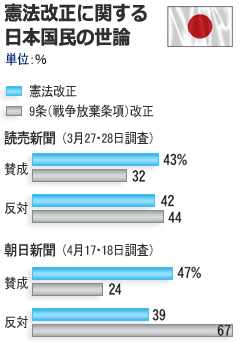
(graph from Chosun Online. Graph shows Asahi and Yomiuri Polls.
Constitution revision necessary?
Yomiuri Yes - 43% No - 42%
Asahi Yes - 47% No - 39%
Should Article 9 be changed?
Yomiuri Yes - 32% No - 44%
Asahi Yes - 24% No - 67%
This has been an overall trend in many polls - people can agree to the general idea of constitutional revision, but it is generally the case that more people want to keep Article 9 as it is.
On May 18, 2010, the three-year freeze on the National Referendum Law was removed. Here are various news reports on the topic.
TOKYO (Kyodo News)— A law on a referendum for revising the Constitution came into effect on Tuesday, three years after its enactment, setting the scene for people to vote on any proposed revision of the pacifist Constitution. The National Referendum Law stipulates procedures for constitutional revisions and allows revision proposals to be submitted to the Diet at any time.
But the deliberative councils on the Constitution in both houses of the Diet, where draft revision proposals are to be deliberated, have so far been dormant. The law was enacted in 2007 by a coalition led by the then ruling Liberal Democratic Party as part of the party’s House of Councillors election manifesto.
However, the Democratic Party of Japan, which wrested power from the LDP in the House of Representatives election last August, has been reluctant to debate the issue as one of its coalition partners—the Social Democratic Party—staunchly opposes changing the Constitution.
As the law allows people aged 18 or older to vote in a referendum on revising the Constitution, it requires that other relevant laws also be revised before its enforcement to lower the age to 18 from 20 to be eligible to vote in elections, but the government has taken no concrete steps, citing the need for more discussion.
Meanwhile, the main opposition LDP has been studying revisions to its draft new constitution worked out in 2005 to make it more conservative, ahead of this summer’s upper house election.


 黄 圭
黄 圭